
Curriculum
| Code | Title | Hours |
|---|---|---|
| Core Requirements | 45 | |
| Major Requirements | 43 | |
| Electives | 32 | |
Minor: Optional | ||
| Total Hours | 120 | |
Major Requirements
| Code | Title | Hours |
|---|---|---|
| Required Core Courses | ||
BIO 1801 |
Human Anatomy and Physiology I
This course begins with a study of the cell and cellular processes and tissues. It continues with investigation of the integumentary, skeletal, muscular, and nervous systems. Students must consult with their academic advisor or the Academic Advising office before enrolling in this course. Laboratory course. | |
HHP 1530 |
Advanced Weight Training
This course analyzes the techniques and skills of weight training to achieve individual goals. The course will go over various core lifts, Olympic lifts, and repetition strength testing. | |
MATH 2050 |
Statistics I
This course presents the basic methods of sampling and interpreting data, probability, the normal distribution, correlation, hypothesis testing and confidence intervals. | |
PSY 1010 |
General Psychology
This course is an introductory survey course acquainting the student with the procedures, principles, theories, and vocabulary of psychology as a science. | |
| Required Major Courses | ||
| BIO 1802 | 4 | |
| EXS 2225 |
Introduction to Exercise Science
This course provides an examination of the career paths in the field of exercise science. Students will learn about the requirements, credentials, examinations, and continuing education required to prepare for these careers. Students will examine the intersection of their passion, profession, and vocation throughout the course. | 1 |
| EXS 2275 |
Administration of Exercise Science Programs
This course introduces the student to administrative aspects of exercise, fitness and sport programs including leadership, organizational structure, budget principles, legal considerations, ethics, event management, and safety considerations. | 3 |
| EXS 2280 |
Psychology of Sport
This course provides an examination of psychosocial factors contributing to sport performance, skill or occupational performance, and making health-related decisions such as participating in physical activity or exercise. Students will learn healthcare and performance applications and strategies for self-improvement. | 3 |
| EXS 3342 |
Nutrition for Wellness and Performance
This course introduces the student to principles of nutrition. It emphasizes the importance of good nutrition to promote a healthy lifestyle, enhance performance, prevent injury and foster wellness throughout life. Real world application is emphasized. | 3 |
| EXS 3373 |
Motor Development
This course focuses on developmental principles as they apply to movement and are influenced by the maturation process. An integrative approach will be used emphasizing the role of movement and physical activity in an individual’s total growth and development from birth through adulthood. | 3 |
| EXS 3375 |
Biomechanics
This course provides students with an understanding of the principles of physics which govern effective and efficient movement. This knowledge is essential for teaching skills, analyzing movement, conducting injury rehabilitation programs and other activities involving the development and use of the human body. | 3 |
| EXS 3442 |
Exercise Testing and Prescription
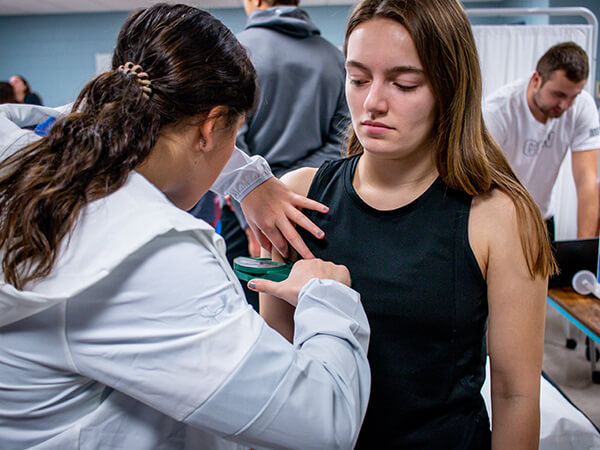
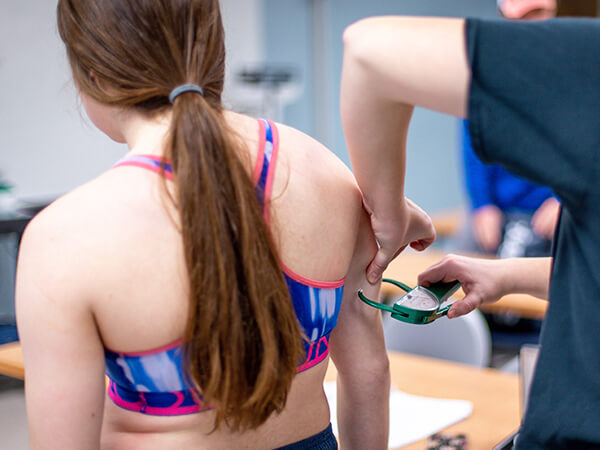
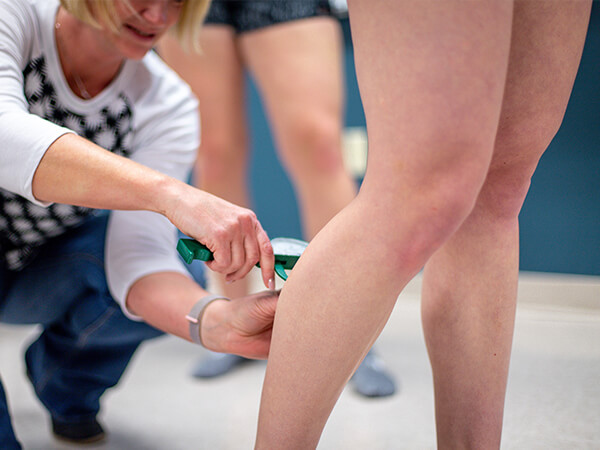
This course examines the theoretical and applied knowledge required to conduct safe and effective exercise tests and fitness evaluations for healthy and at risk populations. Application to exercise program design is included. | 4 |
| EXS 3470 |
Exercise Physiology
This course provides an examination of the common acute responses and chronic adaptations to physical activity and exercise. Laboratory assessment of common physiological responses to exercise is included. | 4 |
| EXS 3471 |
Advanced Exercise Physiology
This course provides an advanced examination of the acute responses and chronic adaptations of the body to physical activity and exercise. Laboratory assessment of common physiological responses to exercise is included. | 4 |
| EXS 4475 |
Research in Exercise Science
This course requires students to select and present research articles from current topics in Exercise Science. Students will analyze, evaluate and discuss the methodology of the selected research topics. The importance of the Institutional Review Board in conducting research will be covered as a preparation for the EXS 4995 Senior Seminar research project. | 2 |
| EXS 4480 |
Strength and Conditioning Program Design
This course will examine the various anatomical and physiological aspects associated with strength and conditioning. The students will have opportunities to analyze and design a strength and conditioning program for athletes from various sports or for individuals with special needs.
| 3 |
| EXS 4494 |
Exercise and Chronic Disease
This course is an examination of the characteristics, physiological responses and exercise-related adaptations in individuals with select chronic diseases. Emphasis will be on pathophysiology and clinical considerations including exercise limitations, responses, and adaptations for each disease state.
| 3 |
| EXS 4995 |
Senior Seminar in Exercise Science
This course provides students with a research experience in the exercise science field. Emphasis is placed on data collection and analysis and completion of a research presentation or publication. | 3-6 |
| or EXS 4960 | Internship | |
| Recommended Electives | ||
HHP 2265 |
Healthy Lifestyles
This course examines modifiable and non-modifiable risk factors for common health conditions and the interpersonal factors that impact health-related decisions. Students will learn to apply theories of behavior change, personal advocacy, and health-related communication techniques to individuals. | |
HHP 2260 |
School and Community Health
This course provides an examination of school and community based healthcare issues, including healthcare systems, social determinants of health and other factors related to health decisions, and methods to create effective change in schools and communities. Students will learn to examine current community health trends, as well as risk mitigation, quality improvement, and intervention techniques. | |
BIO 1401 |
General Biology I
This course is an introductory laboratory course which contains a heavy emphasis on the cell, its structures, and the processes which take place inside the smallest of living units. Laboratory course. | |
BIO 1402 |
General Biology II
This course is a continuation of BIO 1401 that focuses on the biological processes that occur at the system level in both plants and animals. Topics such as transportation, organism control, nutrient breakdown and utilization will be compared in different organisms. Laboratory course. | |
BIO 4800 |
Human Physiology
This course focuses on medical physiology with emphasis on cellular and organ system physiology. Functions of circulation, respiration, heat regulation, water balance, neuromuscular mechanisms, neural and endocrine integration will be included. | |
CHEM 1204 |
Elements of General and Biological Chemistry
This course introduces the student to elements of general, organic, and biological chemistry and is recommended for students seeking a career in nursing. Note: Advisor placement, satisfactory performance on the chemistry placement exam, or completion of CHEM 1003 or MATH 1280 with a C- or better is required. | |
CHEM 1414 |
General Chemistry I
This course introduces the student to general concepts of chemistry including atomic and molecular structure, reaction stoichiometry, thermodynamics, periodic trends, gas laws, and intermolecular forces. Note: Advisor placement, satisfactory performance on the chemistry placement exam, or completion of CHEM 1003 or CHEM 1204 with a C- or better is required. | |
CHEM 1424 | ||
PHYS 1514 |
General Physics I
This introductory course includes classical mechanics, mechanical waves, and sound. It involves the use of algebra and trigonometry, and it emphasizes both numerical problem-solving and building logical arguments based on physics concepts. Note: Advisor placement, satisfactory performance on the physics placement exam, or completion of MATH 1280 with a C- or better is required. | |
PHYS 1524 |
General Physics II
This course is a continuation of PHYS 1514 and includes classical electricity and magnetism, electric current and circuits, light waves, geometric optics, and the atom. Note: Completion of PHYS 1514 or 1714 with a C- or better is required. | |
PSY 2300 |
Life Span Development
This course covers changes throughout the life span from conception until death. Of primary importance are the changes that occur within the three domains of development—the physical, the cognitive, and the socio-emotional. | |
PSY 4250 |
Abnormal Psychology
This course studies behavioral disorders in adults and children with special emphasis on the effects of social conditions and social change on the nature and incidence of maladaptive behaviors in American society and an emphasis on the major contemporary approaches to therapy used in the treatment of these disorders. | |
RSC 3020 |
Advanced Anatomy
This course is an integrated approach to the anatomy of the human body, with particular emphasis on the musculoskeletal, cardiovascular and nervous systems and their application to movement and clinical conditions. Additionally, the course will include the study of cadavers, guiding the student in the identification and function of various systems. | |
| Total Hours | 43-46 | |
- 1
Although CHEM 1414 General Chemistry I/CHEM 1424 General Chemistry II, and PHYS 1514 General Physics I/PHYS 1524 General Physics II are recommended for all Exercise Science majors, only Pre Physical Therapy are required to take them for admittance into a Physical Therapy program. Students should check with their advisor for further information on options within the Exercise Science curriculum.