Concordia University Wisconsin’s scenic Mequon campus overlooking Lake Michigan is a defining part of the student experience today. Yet for much of its history, Concordia’s home was in the heart of Milwaukee.
The history of Concordia
Founded in 1881, Concordia began with an inaugural class of 13 students meeting in the basement of Trinity Lutheran Church in downtown Milwaukee. One year later, the university purchased property on 31st Street between State and Highland Streets, establishing its first permanent campus.
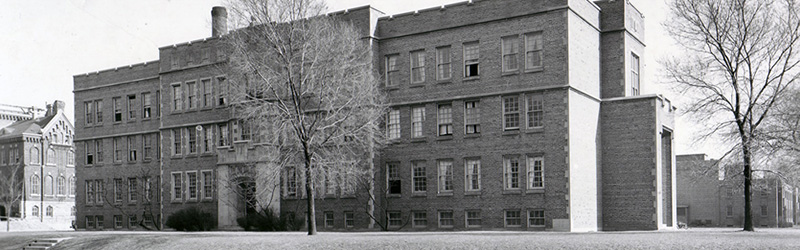
For the next eight decades, Concordia College provided high school education and the first two years of a liberal arts program, emphasizing classical, technical, and religious instruction. The institution played a key role in preparing students for service in the ministry of the Lutheran Church–Missouri Synod (LCMS).
In Christ, new beginnings
In 1978, the LCMS authorized Concordia to become a four-year, accredited college, expanding academic offerings to include programs such as teacher education, nursing, social work, and engineering. This growth led to a pivotal moment in 1982, when the LCMS purchased the former School Sisters of Notre Dame campus in Mequon, relocating Concordia just north of Milwaukee and creating space for long-term growth.

Concordia achieved university status on August 27, 1989, becoming the first university within the Concordia University System.
Recent years
A new chapter began in 2012 with the formation of a strategic relationship between Concordia University Wisconsin and Concordia University Ann Arbor. Today, the university operates as one institution with two campuses, along with a portfolio of online programs serving students nationwide and around the world.
Concordia University has experienced significant growth in academic scope, facilities, and mission impact in recent years. On the Mequon campus, the 2011 opening of Patrick T. Ferry Hall, home to the School of Pharmacy, marked a major investment in health professions education and interprofessional learning. In addition, the construction of the Robert W. Plaster Free Enterprise Center in 2019 expanded opportunities in business education, innovation and entrepreneurship. Growth in student life included new residential facilities such as Chemnitz Hall, supporting a vibrant campus community.
As part of this expansion, Concordia also established new health sciences clinics that strengthen experiential learning while addressing unmet community needs. The on-campus Speech, Language & Hearing Clinic, located in the Robert W. Plaster Free Enterprise Center, serves individuals with speech, language, communication, swallowing, and hearing disorders while providing supervised, hands-on clinical training for future speech-language pathologists. In addition, the CUW Interprofessional Clinic brings together occupational therapy, physical therapy, and other health and social care disciplines to serve underserved populations through collaborative care that complements existing community providers and reflects Concordia’s commitment to skill, compassion, and purpose-driven service.
Athletics and campus life were also strengthened through the development of facilities such as Kapco Park, Tomasini Stadium, and the Catalyst Sports Training Center, reinforcing Concordia’s commitment to the holistic development of students in mind, body, and spirit.
During this same period, Concordia broadened its graduate, doctoral and online offerings to meet the evolving needs of the Church, the professions and a changing higher education landscape. Among these developments is the expansion of academic offerings in emerging and high-demand fields including nursing, business, education, pharmacy, health professions, engineering and others. New and growing programs include study in artificial intelligence, reflecting the university’s engagement with advancing technologies through a Christian ethical lens; continued investment in engineering education, supporting innovation and applied problem-solving; and the development of a direct-entry nursing program, strengthening pathways into the nursing profession and supporting workforce needs in health care.
Guided by its Lutheran identity and a strategic plan for 2024–28, Concordia University continues to grow with purpose, developing students in mind, body, and spirit for service to Christ in the Church and the world.